Sunday, April 20, 2014

Reusable Water

Forget Plastic Bottles

Why are people wasting their money on disposable plastic water bottles when they have an unlimited supply of water 20 feet away in their sink? Some say convenience, some say it’s healthier, and some say it just tastes better. Some may think so; however they probably have never tried reusable bottles. In doing so they're actually hurting their health, their wallet, and the planet. 

Health Hazards of Plastic

Since you can buy them at a grocery store, it seems obvious that bottles of water would be much safer than that stuff coming from your faucet. That's not necessarily true. There are a lot of hazards and unknowns about bottled water that are concerning to the average American.
  • The FDA only regulates about 30-40% of bottled water. 
  • According to one study, 22% of tested brands had chemical levels above state limits.
  • Most plastic bottles contain BPA which can cause brain and reproductive dysfunction.
When purchasing a reusable bottle you can ensure that your bottles do not contain harmful BPA. You can also ensure that your water is safer and cleaner than the bottled water whose origin is a mystery. It's easy to find out if your area's water is safe. If you feel uncomfortable drinking from a tap, a sink filter is another cheap alternative. 

 Pocket Money


In the long run, purchasing a $20 reusable water bottle will save you so much money. Fun fact: Americans spend about as much money a year on disposable bottles as they do on engagement rings. There is a huge difference between the cost of bottled water and water from the tap. 

  • Bottled water costs 300-2000x more than tap water
  • Drinking the recommended 8 glasses of water per year costs…
    • $1,400 for bottled water
    • $0.50 for tap water
  • You can save $550 a year (one disposable bottle a day) by drinking from a reusable bottle

 The Environment


A switch to reusable water bottles can have a hugely positive impact on the environment. From production all the way through disposal, the use of regular plastic bottles is taking a toll on the planet. It also uses up some of our most precious resources to produce bottles of water. 
  • It takes over 50 million barrels of oil to produce and refrigerate bottled water. 
  • 3x the amount of water are used to produce a bottle than to fill it.
  • Over 80% of water bottles go to landfills.
  • When bottles decompose they release toxic chemicals.
  • Plastic bottles and bags make up the majority of ocean and beach litter.
As a whole, it is a good decision to switch from disposable plastic water bottles to reusable ones. They're safer, cheaper, and more environmentally friendly. It's a pretty easy choice to make, so what's stopping you?

Tuesday, April 15, 2014

Sustainability Professionals

As World Becomes Greener, Demand for Sustainable Professionals Grows
Just a few years ago jobs in sustainability weren't prominent. There were few institutions that began a focus on sustainability but you could hardly call anybody a professional. Today, everything has changed. Nearly all towns, school districts, universities, government agencies and corporations have somebody managing sustainability initiatives. Consequently the demand for workers in sustainability jobs have skyrocketed.

What makes a sustainability professional?

Sustainability professionals are in charge of leading green initiatives in their business or organization. Because this is still a new idea to many, it can be difficult to know what a sustainability professional needs to be successful. Some of these important traits include:


  • Diversity: Companies looking for sustainability workers want to see that they have worked for different sectors, companies, and on different projects. They feel that it gives them the well-rounded knowledge they will need as innovators in the company.
  • Vision: Sustainability people need vision. They need to think differently than everyone else to be able to take on their challenges and attack them in a new way. 
  • Specialists: While professionals must be knowledgeable about different topics, they must have at least one area of expertise. Especially as sustainability departments within businesses and organizations grow.
  • Leadership: For many businesses and organizations, creating a greener company comes with the need for a full overhaul . For this, one must be a firm leader willing to take action and bring about that change. 
  • Business Knowledge: The bottom line is that a company wants to make money. It's great to have awesome ideas but if they are not going to be financially effective for the organization, they are essentially useless. A person going into sustainability should have some background and education in the business world so they can meld the two together. 


Going into a career in sustainability might not have ever been something that you thought would be for you. However, with the growth of job availability in all industries, anyone can find the right fit for them. It might be a good idea to think about making the switch over to a job helping to save the planet, one business at a time. 

Wednesday, April 9, 2014

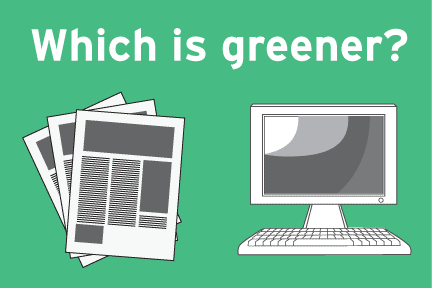
Digital Vs. Paper

Digital is more sustainable than paper...

Or so you thought.

For the last few years companies have been drastically changing their practices to use less paper. The reasoning behind the change is to be more sustainable and to save trees. Now, everything is digital. Books, bills, newspapers, even receipts are available online or emailed directly to you. There is a stigma against using paper, because it is bad for the environment.

However, is paper really as horrible as people make it out to be? 

Not necessarily. And now non-profit groups are out to prove it. The large claim against paper is that the manufacturing of it is leading to deforestation. While this may have been true in the past, a large portion of paper being sold is actually recycled, meaning fewer new trees are being cut down than planted.
  • In 2011 66.8% of paper used was recycled. 
  • Forest coverage from Minnesota to Maine has increased by 28% in the past century (US Department of Agriculture). 

It's easy to say that digital is more sustainable than paper because you can use it over and over again for new information, while paper updates are constantly reprinted. A few important things to keep in mind about digital media:
  • Manufacturing any electronic products leaves a carbon footprint
  • It takes a lot of energy to power electronics and this energy adds to our carbon footprint as well
  • E-Waste is a serious issue and causes health hazards to humans, especially in developing countries

Which is better?

It is difficult to determine exactly which medium, digital or paper, is better for the environment. Because they are so different and because digital is so much newer than paper it will take years to accurately measure the two to compare them. 

Although there is no way to decide which type of publishing is better for the environment, it is certain that moving away from paper and going digital is more cost-effective for companies. For this reason, we will surely continue to see companies moving toward digital. 

Next time a company says they are going paperless to help the environment, remember that this is not necessarily the case. The company is probably just trying to maximize their profits.